3. Zep / Graphiti
The idea in one screen. Zep stores what a user said as a graph. The things mentioned (people, places, a diet, an allergy) are nodes. Each fact is an edge between two nodes, and every edge carries the dates between which it was true. When the user changes their mind, the old edge is not deleted and not overwritten: it gets an end date.
Every message goes through the same four steps, and each step makes one or more model calls.
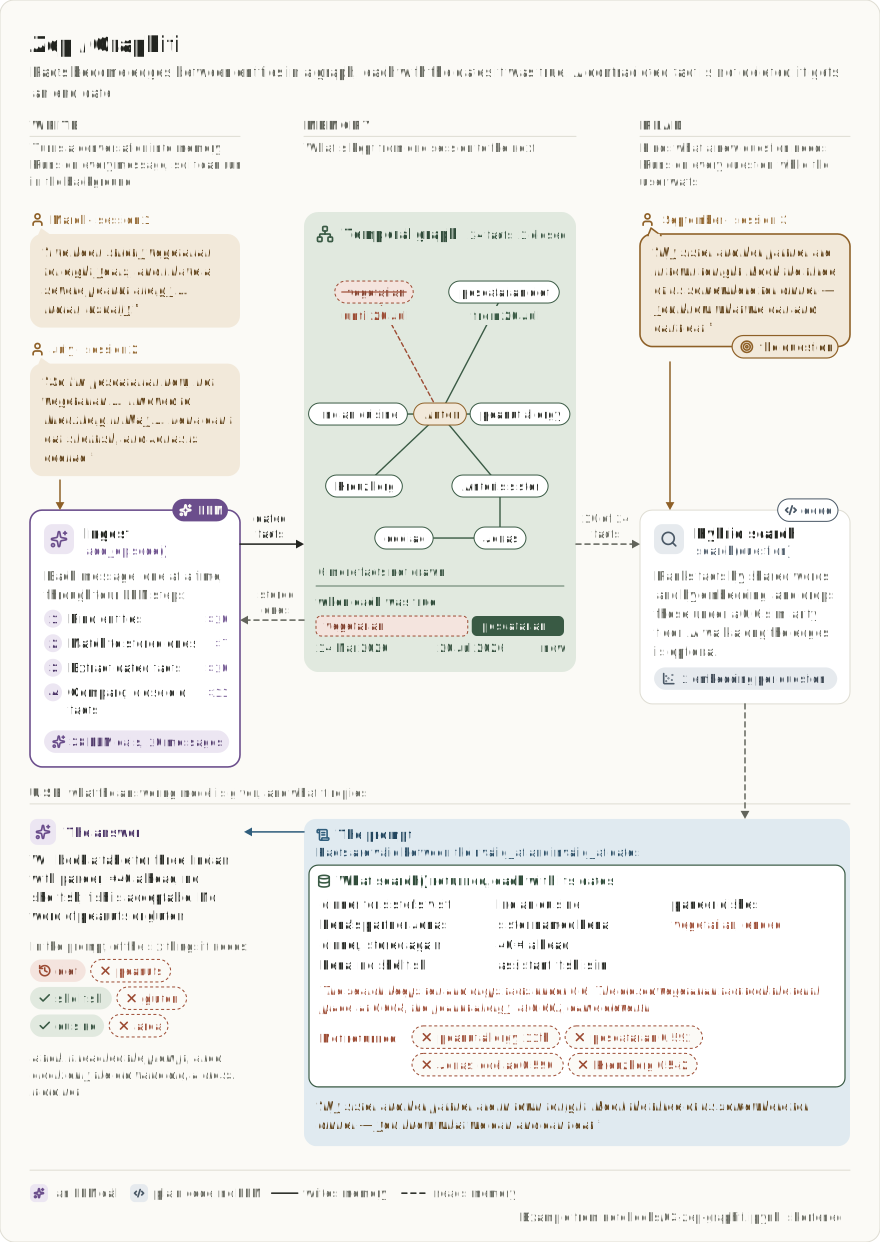
Reading is a search over the facts, by wording and by meaning, with the dates attached to each result so the model can tell a current fact from a past one.
This notebook walks through those steps on a short conversation in which the user changes their diet, and tries to answer four questions:
- Writing. What goes into the graph, and what is silently left out?
- Revising. What happens to the old fact when a new one contradicts it?
- The graph. What does it give you that a table of dated facts would not?
- Cost. What does it cost in model calls?
Reading, the remaining stage every notebook in this series looks at, is section 4.
What is run here
Zep is the hosted product. Graphiti is the open-source engine under it (getzep/graphiti, Apache-2.0), described in the Zep paper.
This notebook is a simplified re-implementation, written so that every
step can be read. It does not call graphiti.add_episode(). Instead:
- The prompts are Graphiti's own, imported from the
graphiti-corepackage (version 0.31.1, the version the experiment in this repository runs), together with its thresholds. - The control flow around them is ours: about 150 lines of plain Python
that follow Graphiti's
add_episodestep by step, including its rules for dates. - The graph is kept in Python objects. There is no graph database.
Left out: entity summaries, structured attributes, communities, the cross-encoder reranker, and a fuzzy comparison of long entity names that runs before the model is asked (it needs a near-exact spelling, and no pair of names in this conversation comes close). None of them changes what happens to a fact here. The numbers below are one small model's behaviour inside Graphiti's prompts, not the behaviour of Zep's hosted service.
The model is called with temperature 0, but its wording still varies: a small change to a prompt, such as one extra label on an entity, changes the sentences it writes. An earlier run of this notebook, on Graphiti 0.30, stored the same facts in slightly different words, and section 4 shows why that matters.
Setup
The models are set in config.py, which also reads
GEMINI_API_KEY from the .env at the top of the repository.
The outputs below are from one run. Model replies vary between runs, even at temperature 0 and with the same prompt, so a rerun can differ in details from what is shown here, and a different model can change more. The mechanism stays the same.
Code · 32 lines
import json
import math
import re
import textwrap
from collections import Counter
from dataclasses import dataclass, field
from datetime import datetime, timezone

import graphviz
import numpy as np
import pandas as pd
from IPython.display import SVG, display
from pydantic import BaseModel

from config import CHAT_MODEL, EMBED_MODEL, embed, generate

pd.set_option("display.max_colwidth", None)
pd.set_option("display.width", 200)


def table(frame):
    """A table with text on the left and numbers on the right, each header over its column."""
    numbers = frame.select_dtypes("number").columns
    return (frame.style.hide(axis="index").format(precision=3, thousands=",", na_rep="")
            .set_table_styles([{"selector": "th", "props": "text-align: left;"},
                               {"selector": "td", "props": "text-align: left; white-space: pre-wrap;"},
                               {"selector": "caption", "props": "text-align: left; font-weight: bold;"}])
            .set_table_styles({column: [{"selector": "", "props": "text-align: right;"}] for column in numbers},
                              overwrite=False))


print(f"chat model: {CHAT_MODEL}   embedding model: {EMBED_MODEL}")
chat model: gemini-3.1-flash-lite embedding model: gemini-embedding-001
Two helpers make the model calls. Each one writes a line to a log, so that at the end we can count what every step cost.
Code · 22 lines
CALLS = []    # one entry per LLM call
EMBEDS = []   # one entry per embedding call


def llm(step, messages, schema):
    """Send one of Graphiti's prompts to the model and return the reply as a dict."""
    system, prompt = messages[0].content, messages[1].content
    reply = generate(prompt, system=system, schema=schema)
    answer = json.loads(reply.text)
    CALLS.append({
        "step": step, "prompt": prompt, "reply": answer,
        "tokens in": reply.usage_metadata.prompt_token_count,
        "tokens out": reply.usage_metadata.candidates_token_count,
    })
    return answer


def embed_texts(texts, why):
    """Turn texts into unit-length vectors, so a dot product is a cosine similarity."""
    vectors = np.array(embed(texts))
    EMBEDS.append({"why": why, "texts": len(texts)})
    return vectors / np.linalg.norm(vectors, axis=1, keepdims=True)
The conversation
The conversation from notebook 0, repeated here so that this notebook runs on its own. Two sessions four months apart, then a question in a third. Session 2 reverses something from session 1 (the diet) and adds two people.
Code · 56 lines
USER = "Anton"

SESSION_1 = [  # 14 March 2026
    ("user", "I'm planning a dinner for my sister's visit to Berlin next week. "
             "Worth saying up front: I've been strictly vegetarian for eight years, "
             "and I have a severe peanut allergy — anaphylactic, not a preference."),
    ("assistant", "Understood — no meat, and peanuts are a hard exclusion. Any cuisine you lean towards?"),
    ("user", "Indian, usually. Paneer dishes especially. And I'd rather not spend more "
             "than about 40 euros a head."),
]

SESSION_2 = [  # 20 July 2026, four months later
    ("user", "Small update on the food thing — I started eating fish about a month ago. "
             "So I'm pescatarian now, not vegetarian. Still no meat, and the peanut "
             "situation obviously hasn't changed."),
    ("assistant", "Noted, fish is in. Anything else shifted?"),
    ("user", "I moved to Kreuzberg in May, so anything walkable from there is a plus."),
    ("assistant", "Kreuzberg, noted. Anything else for next time?"),
    ("user", "Yes — my sister Lena is coming back in the autumn, and she's bringing her partner, Jonas."),
    ("assistant", "Lovely. Anything I should know about what they eat?"),
    ("user", "Lena can't eat shellfish, and Jonas is coeliac."),
]

QUESTION = (  # a new session in September, with no transcript
    "My sister and her partner are in town tonight. Book the three of us somewhere "
    "for dinner — you know what we can and can't eat."
)

SESSION_DATES = {
    "s1": datetime(2026, 3, 14, 19, 0, tzinfo=timezone.utc),
    "s2": datetime(2026, 7, 20, 19, 0, tzinfo=timezone.utc),
}
TODAY = datetime(2026, 9, 1, tzinfo=timezone.utc)


def as_messages(key, session):
    """Graphiti takes one message at a time, with the speaker's name in the text."""
    speaker = {"user": USER, "assistant": "Assistant"}
    return [
        {"label": f"{key}.{i + 1}", "role": role, "content": f"{speaker[role]}: {text}",
         "time": SESSION_DATES[key].replace(minute=i)}
        for i, (role, text) in enumerate(session)
    ]


MESSAGES = as_messages("s1", SESSION_1) + as_messages("s2", SESSION_2)


def show_session(caption, turns):
    """One session as a table, under its date."""
    return table(pd.DataFrame(turns)).set_caption(caption)


display(show_session("Session 1 · 14 March 2026", [{key: m[key] for key in ("label", "time", "content")} for m in MESSAGES if m["label"].startswith("s1.")]))
display(show_session("Session 2 · 20 July 2026, four months later", [{key: m[key] for key in ("label", "time", "content")} for m in MESSAGES if m["label"].startswith("s2.")]))
display(show_session("Session 3 · 1 September 2026, with no transcript", [{"content": f"{USER}: {QUESTION}"}]))
| label | time | content |
|---|---|---|
| s1.1 | 2026-03-14 19:00:00+00:00 | Anton: I'm planning a dinner for my sister's visit to Berlin next week. Worth saying up front: I've been strictly vegetarian for eight years, and I have a severe peanut allergy — anaphylactic, not a preference. |
| s1.2 | 2026-03-14 19:01:00+00:00 | Assistant: Understood — no meat, and peanuts are a hard exclusion. Any cuisine you lean towards? |
| s1.3 | 2026-03-14 19:02:00+00:00 | Anton: Indian, usually. Paneer dishes especially. And I'd rather not spend more than about 40 euros a head. |
| label | time | content |
|---|---|---|
| s2.1 | 2026-07-20 19:00:00+00:00 | Anton: Small update on the food thing — I started eating fish about a month ago. So I'm pescatarian now, not vegetarian. Still no meat, and the peanut situation obviously hasn't changed. |
| s2.2 | 2026-07-20 19:01:00+00:00 | Assistant: Noted, fish is in. Anything else shifted? |
| s2.3 | 2026-07-20 19:02:00+00:00 | Anton: I moved to Kreuzberg in May, so anything walkable from there is a plus. |
| s2.4 | 2026-07-20 19:03:00+00:00 | Assistant: Kreuzberg, noted. Anything else for next time? |
| s2.5 | 2026-07-20 19:04:00+00:00 | Anton: Yes — my sister Lena is coming back in the autumn, and she's bringing her partner, Jonas. |
| s2.6 | 2026-07-20 19:05:00+00:00 | Assistant: Lovely. Anything I should know about what they eat? |
| s2.7 | 2026-07-20 19:06:00+00:00 | Anton: Lena can't eat shellfish, and Jonas is coeliac. |
| content |
|---|
| Anton: My sister and her partner are in town tonight. Book the three of us somewhere for dinner — you know what we can and can't eat. |
A correct answer to the question needs six things from those two sessions: pescatarian (no longer vegetarian), no peanuts, no shellfish for Lena, no gluten for Jonas, a liking for Indian food, and somewhere near Kreuzberg.
The graph
Two kinds of object. An entity is a node: a name and a type. A fact is an edge from one entity to another: a relation name, a sentence, and four dates that are explained further down.
Code · 26 lines
@dataclass(eq=False)
class Entity:
    name: str
    kind: str = "Entity"
    vector: np.ndarray = None       # embedding of the name


@dataclass(eq=False)
class Fact:
    source: str                     # name of the entity the edge starts at
    target: str                     # name of the entity it points to
    relation: str                   # e.g. LIVES_IN
    text: str                       # the fact as a sentence
    valid_at: datetime = None       # when it became true in the world
    invalid_at: datetime = None     # when it stopped being true in the world
    created_at: datetime = None     # when the graph learned it
    expired_at: datetime = None     # when the graph stopped believing it
    said_in: str = ""               # label of the message it came from
    vector: np.ndarray = None       # embedding of the sentence


@dataclass
class Graph:
    entities: dict = field(default_factory=dict)    # name -> Entity
    facts: list = field(default_factory=list)
    messages: list = field(default_factory=list)    # messages ingested so far
And a function to draw it. Entities are boxes, coloured by type. Facts are arrows labelled with their relation. A fact that has been given an end date is drawn dashed and grey.
Code · 55 lines
KIND_COLOURS = {"Person": "#dbe9f6", "Place": "#e3f1e3", "Preference": "#fff1c9",
                "HealthCondition": "#f9dcdc", "Entity": "#eeeeee"}


def day(moment):
    return moment.strftime("%Y-%m-%d") if moment else "—"


def two_lines(text, separator, longest=14):
    """Break a long label in two at the separator nearest its middle."""
    places = [i for i, c in enumerate(text) if c == separator]
    if len(text) <= longest or not places:
        return text
    middle = min(places, key=lambda i: abs(i - len(text) / 2))
    return text[:middle + 1].rstrip() + "\n" + text[middle + 1:]


def draw(graph, highlight=()):
    """Draw the graph. `highlight` is a list of facts to draw in bold blue."""
    picture = graphviz.Digraph(
        # `size` is in inches: the picture is scaled down if it would be wider than 8.4
        graph_attr={"rankdir": "LR", "bgcolor": "white", "nodesep": "0.2", "ranksep": "0.45",
                    "size": "8.4,30"},
        node_attr={"shape": "box", "style": "rounded,filled", "fontname": "Helvetica", "fontsize": "11"},
        edge_attr={"fontname": "Helvetica", "fontsize": "9"},
    )
    for entity in graph.entities.values():
        picture.node(entity.name, f"{two_lines(entity.name, ' ')}\n({entity.kind})",
                     fillcolor=KIND_COLOURS.get(entity.kind, "#eeeeee"))
    for fact in graph.facts:
        label = two_lines(fact.relation, "_")
        style = {}
        if fact.invalid_at:
            label += f"\nuntil {day(fact.invalid_at)}"
            style = {"style": "dashed", "color": "#999999", "fontcolor": "#999999"}
        if fact in highlight:
            style = {"color": "#1f6fb2", "fontcolor": "#1f6fb2", "penwidth": "2.5"}
        picture.edge(fact.source, fact.target, label=label, **style)
    return picture


def facts_table(facts):
    return pd.DataFrame([
        {"from": f.source, "relation": f.relation, "to": f.target, "fact": f.text,
         "valid_at": day(f.valid_at), "invalid_at": day(f.invalid_at),
         "created_at": day(f.created_at), "expired_at": day(f.expired_at)}
        for f in facts
    ])


def show_prompt(prompt, width=110):
    """Print a prompt with long lines wrapped and the worked examples left out."""
    prompt = re.sub(r"<EXAMPLE>.*?</EXAMPLE>\n*", "", prompt, flags=re.S)
    for line in prompt.strip().splitlines():
        print(textwrap.fill(line, width, subsequent_indent="    ") if line.strip() else "")
1. One message, step by step
The first message of session 1 is the one that states the diet and the allergy.
Step 1: find the entities
The model is asked to list the things the message mentions. The prompt is
Graphiti's extract_nodes.extract_message.
Code · 47 lines
from graphiti_core.prompts import dedupe_edges, dedupe_nodes, extract_edges, extract_nodes
from graphiti_core.search.search_utils import DEFAULT_MIN_SCORE, MAX_SEARCH_DEPTH, RELEVANT_SCHEMA_LIMIT
from graphiti_core.utils.maintenance.node_operations import (
    NODE_DEDUP_CANDIDATE_LIMIT, NODE_DEDUP_COSINE_MIN_SCORE, _build_entity_types_context,
    _get_entity_type_description,
)
from graphiti_core.utils.maintenance.temporal_edge_utils import normalize_future_temporal_bounds


def type_labels(entity):
    """The type labels Graphiti puts on a node: always "Entity", plus the custom type if there is one."""
    return ["Entity"] if entity.kind == "Entity" else ["Entity", entity.kind]


def previous_messages(graph):
    """What Graphiti passes along as context: the last few messages already ingested.

    The paper says the last four. The library passes up to ten.
    """
    return [{"content": m["content"], "timestamp": m["time"].isoformat()}
            for m in graph.messages[-RELEVANT_SCHEMA_LIMIT:]]


def find_entities(graph, message, entity_types=None):
    types = _build_entity_types_context(entity_types)   # the default type, plus any we define
    reply = llm("1. find entities", extract_nodes.extract_message({
        "episode_content": message["content"],
        "episode_timestamp": message["time"].isoformat(),
        "previous_episodes": previous_messages(graph),
        "entity_types": types,
        "custom_extraction_instructions": "",
        "source_description": "chat with a booking assistant",
    }), extract_nodes.ExtractedEntities)

    found = {}
    for item in reply["extracted_entities"]:
        name = item["name"].strip()
        if name and name not in found:
            found[name] = Entity(name, kind=types[item["entity_type_id"]]["entity_type_name"])
    return list(found.values())


graph = Graph()
first = MESSAGES[0]
default_found = find_entities(graph, first)
CALLS[-1]["message"] = "s1.1, default types"
table(pd.DataFrame([{"entity": e.name, "type": e.kind} for e in default_found]))
| entity | type |
|---|---|
| Anton | Entity |
| Anton's sister | Entity |
| Berlin | Entity |
Three entities: the speaker, the sister, the city. The vegetarian diet and the peanut allergy are not there. Those are the two things this conversation is about, and one of them is life-threatening.
This matters more here than it would in another system, because of how the later steps work: a fact is stored as an edge between two entities, and the step that writes facts is shown this list. Step 3 below shows what it makes of the message with only these three.
Why did the model leave them out? Because the prompt tells it to. Here are the instructions it was given (the worked examples are left out for length):
Code · 1 line
show_prompt(CALLS[-1]["prompt"])
NEVER extract any of the following:
- Pronouns (you, me, I, he, she, they, we, us, it, them, him, her, this, that, those)
- Abstract concepts or feelings (joy, balance, growth, resilience, happiness, passion, motivation)
- Generic common nouns or bare object words (day, life, people, work, stuff, things, food, time,
  way, tickets, supplies, clothes, keys, gear)
- Generic media/content nouns unless uniquely identified in the node name itself (photo, pic, picture,
  image, video, post, story)
- Generic event/activity nouns unless uniquely identified in the node name itself (event, game, meeting,
  class, workshop, competition)
- Broad institutional nouns unless explicitly named or uniquely qualified (government, school, company,
  team, office)
- Ambiguous bare nouns whose meaning depends on sentence context rather than the node name itself
- Sentence fragments or clauses ("what you really care about", "results of that effort")
- Adjectives or descriptive phrases ("amazing", "something different", "new hair color")
- Duplicate references to the same real-world entity. Extract each entity at most once per message,
  even if it appears multiple times or both as a speaker label and in the body text.
- Bare relational or kinship terms (dad, mom, mother, father, sister, brother, husband, wife,
  spouse, son, daughter, uncle, aunt, cousin, grandma, grandpa, friend, boss, teacher, neighbor,
  roommate) and bare animal/pet words (dog, cat, pet, puppy, kitten). These are too generic on
  their own. Instead, qualify them with the possessor: extract "Nisha's dad" not "dad",
  "Jordan's dog" not "dog".
- Bare generic objects that cannot be meaningfully qualified with a possessor, brand, or
  distinguishing detail (e.g., NEVER extract "supplies" from "I picked up some supplies")

Your task is to extract **entity nodes** that are **explicitly** mentioned in the CURRENT MESSAGE.
Pronoun references such as he/she/they or this/that/those should be disambiguated to the names of the
reference entities. Only extract distinct entities from the CURRENT MESSAGE.

<ENTITY TYPES>
[{'entity_type_id': 0, 'entity_type_name': 'Entity', 'entity_type_description': 'A specific, identifiable
    entity that does not fit any of the other listed types. Must still be a concrete, meaningful thing —
    specific enough to be uniquely identifiable. GOOD: a named entity not covered by the other types. BAD:
    "luck", "ideas", "tomorrow", "things", "them", "everybody", "a sense of wonder", "great times". When in
    doubt, do not extract the entity.'}]
</ENTITY TYPES>

<PREVIOUS MESSAGES>
[]
</PREVIOUS MESSAGES>

<CURRENT MESSAGE>
Anton: I'm planning a dinner for my sister's visit to Berlin next week. Worth saying up front: I've been
    strictly vegetarian for eight years, and I have a severe peanut allergy — anaphylactic, not a preference.
</CURRENT MESSAGE>

1. **Speaker Extraction**: Always extract the speaker (the part before the colon `:` in each dialogue line) as
    the first entity node.
   - If the speaker is mentioned again in the message, treat both mentions as a **single entity**.

2. **Entity Identification**:
   - Extract named entities and specific, concrete things that are **explicitly** mentioned in the CURRENT
    MESSAGE.
   - Only extract entities that are specific enough to be uniquely identifiable. Ask: "Could this have its own
    Wikipedia article or database entry, OR is it specific enough to distinguish from other items of the same
    category within this conversation?"
   - For objects, possessions, and physical items, extract when they are specific enough
     to distinguish from other items of the same category. SHOULD be extracted:
     - Brand-named items ("Gamecube", "Ford Mustang", "Moen faucet")
     - Qualified items ("wool coat", "red and purple lighting", "cracked windshield",
       "dog leash")
     - Items with a concrete distinguishing descriptor (color, material, size, model,
       owner, specific use)
     Should NOT be extracted:
     - Bare head nouns alone ("car", "coat", "game", "lighting", "windshield")
   - When a speaker or named person refers to a relative, pet, or associate using a bare term
     (e.g., "my dad", "his cat"), extract the entity qualified with the possessor's name
     (e.g., "Nisha's dad", "Jordan's cat"). Do NOT extract the bare term alone.
   - **Exclude** entities mentioned only in the PREVIOUS MESSAGES (they are for context only).

3. **Entity Classification**:
   - Use the descriptions in ENTITY TYPES to classify each extracted entity.
   - Assign the appropriate `entity_type_id` for each one.

4. **Exclusions**:
   - Do NOT extract entities representing relationships or actions.
   - Do NOT extract dates, times, or other temporal information — these will be handled separately.
   - When in doubt, do NOT extract.

5. **Specificity**:
   - Always use the **most specific form** mentioned in the message. If the message says "road cycling",
     extract "road cycling" not "cycling". If it says "wool coat", extract "wool coat" not "coat".
   - When context makes an object's type clear, include that context in the name. For example, if the
     message mentions forgetting a leash while discussing a dog walk, extract "dog leash" not "leash".
   - If a phrase would not be distinguishable when read alone later, do NOT extract it.

6. **Formatting**:
   - Be **explicit and unambiguous** in naming entities (e.g., use full names when available).
The prompt is written for a knowledge graph of named things. It asks for entities that "could have their own Wikipedia article or database entry", forbids "abstract concepts", and ends with "when in doubt, do NOT extract". A diet and an allergy are attributes of a person, not named things, so a model that follows the instructions leaves them out. This is not a random failure: the temperature is 0 and the result is the same on every run.
Tuning: tell it which kinds of thing matter
Graphiti's answer to this is custom entity types. You describe the kinds of
node your application cares about, and the descriptions are put into the same
prompt under <ENTITY TYPES>. They are written as classes with a docstring,
exactly as they would be passed to add_episode(entity_types=...).
Code · 21 lines
class Person(BaseModel):
    """A specific person: the speaker, or someone they name or describe by their relation to a named person."""


class Place(BaseModel):
    """A named city, district, venue or address."""


class Preference(BaseModel):
    """Something a person likes, dislikes, chooses or avoids: a diet they follow, a cuisine or dish they favour, a budget they keep to."""


class HealthCondition(BaseModel):
    """An allergy, intolerance or medical condition that limits what a person can eat or do."""


ENTITY_TYPES = {"Person": Person, "Place": Place, "Preference": Preference,
                "HealthCondition": HealthCondition}

found = find_entities(graph, first, ENTITY_TYPES)
table(pd.DataFrame([{"entity": e.name, "type": e.kind} for e in found]))
| entity | type |
|---|---|
| Anton | Person |
| Anton's sister | Person |
| Berlin | Place |
| vegetarian | Preference |
| peanut allergy | HealthCondition |
Same message, same model, same prompt apart from the list of types, and now the diet and the allergy are entities. The rest of this notebook uses these four types. Without them there would be no diet fact in the graph, and nothing for session 2 to contradict.
The lesson is that the entity step decides what the memory is able to hold. Out of the box it is tuned for names; for personal preferences it has to be told.
Step 2: match them to entities already in the graph
The same person or thing will be mentioned again, often in different words ("my sister", then "Lena"). This step decides, for each entity just found, whether it is new or one the graph already has.
- An exact name match is reused directly.
- Otherwise the stored entities whose names are close in meaning (cosine
similarity of the name's embedding of at least 0.6, at most 15 of them) are
collected as candidates, and the model is asked whether any of them is the
same thing (
dedupe_nodes.nodes). - With no candidates, the entity is new, and no model call is made.
Code · 41 lines
def match_entities(graph, message, found, entity_types=None):
    """Return {name as found: name in the graph}, adding the new entities to the graph."""
    vectors = embed_texts([e.name for e in found], "entity names")
    stored = list(graph.entities.values())
    same_as, unsure, candidates = {}, [], []

    for entity, vector in zip(found, vectors):
        entity.vector = vector
        exact = [s for s in stored if s.name.lower() == entity.name.lower()]
        if exact:
            same_as[entity.name] = exact[0].name
            continue
        close = sorted(stored, key=lambda s: -float(s.vector @ vector))[:NODE_DEDUP_CANDIDATE_LIMIT]
        close = [s for s in close if float(s.vector @ vector) >= NODE_DEDUP_COSINE_MIN_SCORE]
        if close:
            unsure.append(entity)
            candidates += [s for s in close if s not in candidates]

    if unsure:
        reply = llm("2. match entities", dedupe_nodes.nodes({
            "extracted_nodes": [{"id": i, "name": e.name, "entity_type": type_labels(e),
                                 "entity_type_description": _get_entity_type_description(type_labels(e), entity_types)}
                                for i, e in enumerate(unsure)],
            "existing_nodes": [{"candidate_id": i, "name": c.name, "entity_types": type_labels(c)}
                               for i, c in enumerate(candidates)],
            "episode_content": message["content"],
            "previous_episodes": previous_messages(graph),
        }), dedupe_nodes.NodeResolutions)
        for item in reply["entity_resolutions"]:
            if 0 <= item["id"] < len(unsure) and 0 <= item["duplicate_candidate_id"] < len(candidates):
                same_as[unsure[item["id"]].name] = candidates[item["duplicate_candidate_id"]].name

    for entity in found:
        if entity.name not in same_as:           # nothing matched: it is a new entity
            graph.entities[entity.name] = entity
            same_as[entity.name] = entity.name
    return same_as


same_as = match_entities(graph, first, found, ENTITY_TYPES)
same_as
{'Anton': 'Anton',
 "Anton's sister": "Anton's sister",
 'Berlin': 'Berlin',
 'vegetarian': 'vegetarian',
 'peanut allergy': 'peanut allergy'}
The graph was empty, so all five are new and no model call was needed. This step becomes interesting in session 2.
Step 3: extract the facts
Now the model gets the message again, together with the list of entities, and
is asked for facts between two of them, with dates where the message gives
any (extract_edges.edge).
The prompt warns that a name not in the list "will cause the edge to be rejected". The code does the opposite: since version 0.31, such a name becomes a new entity, matched against the graph like the others, and the fact is kept. In the experiment's logs this happened to 52 of 22,795 facts.
These are the parts of the prompt that change from message to message:
Code · 46 lines
def extract_facts(graph, message, found, same_as, entity_types=None):
    reply = llm("3. extract facts", extract_edges.edge({
        "episode_content": message["content"],
        "nodes": [{"name": e.name, "entity_types": type_labels(e)} for e in found],
        "previous_episodes": previous_messages(graph),
        "reference_time": message["time"],
        "edge_types": [],
        "custom_extraction_instructions": "",
    }), extract_edges.ExtractedEdges)

    # The prompt says a name outside ENTITIES gets the fact rejected. The code does the
    # opposite: such a name becomes a new entity, matched against the graph like any other.
    used = [n.strip() for item in reply["edges"]
            for n in (item["source_entity_name"], item["target_entity_name"]) if n.strip()]
    added = [Entity(name) for name in dict.fromkeys(used) if name not in same_as]
    if added:
        same_as.update(match_entities(graph, message, added, entity_types))

    facts = []
    for item in reply["edges"]:
        source = same_as.get(item["source_entity_name"].strip())
        target = same_as.get(item["target_entity_name"].strip())
        if not source or not target or source == target or not item["fact"].strip():
            continue                              # two distinct entities and a sentence
        valid_at, invalid_at = normalize_future_temporal_bounds(   # a plan is dated by when it was said
            item["fact"], message["time"], parse_date(item.get("valid_at")), parse_date(item.get("invalid_at")))
        facts.append(Fact(source, target, item["relation_type"], item["fact"],
                          valid_at=valid_at, invalid_at=invalid_at,
                          created_at=message["time"], said_in=message["label"]))
    return facts, [e for e in added if same_as[e.name] == e.name]


def parse_date(text):
    if not text:
        return None
    try:
        moment = datetime.fromisoformat(text.replace("Z", "+00:00"))
    except ValueError:
        return None
    return moment if moment.tzinfo else moment.replace(tzinfo=timezone.utc)


new_facts, added = extract_facts(graph, first, found, same_as, ENTITY_TYPES)

prompt = next(c["prompt"] for c in reversed(CALLS) if c["step"].startswith("3."))
print(prompt[prompt.index("<CURRENT_MESSAGE>"):prompt.index("# TASK")].strip())
<CURRENT_MESSAGE>
Anton: I'm planning a dinner for my sister's visit to Berlin next week. Worth saying up front: I've been strictly vegetarian for eight years, and I have a severe peanut allergy — anaphylactic, not a preference.
</CURRENT_MESSAGE>

<ENTITIES>
[{"name": "Anton", "entity_types": ["Entity", "Person"]}, {"name": "Anton's sister", "entity_types": ["Entity", "Person"]}, {"name": "Berlin", "entity_types": ["Entity", "Place"]}, {"name": "vegetarian", "entity_types": ["Entity", "Preference"]}, {"name": "peanut allergy", "entity_types": ["Entity", "HealthCondition"]}]
</ENTITIES>

<REFERENCE_TIME>
2026-03-14 19:00:00+00:00  # ISO 8601 (UTC); used to resolve relative time mentions
</REFERENCE_TIME>
And the reply, as the model returned it:
Code · 4 lines
fact_call = next(c for c in reversed(CALLS) if c["step"].startswith("3."))
table(pd.DataFrame(fact_call["reply"]["edges"]).reindex(
    columns=["source_entity_name", "relation_type", "target_entity_name", "fact", "valid_at", "invalid_at"]
).astype(object).fillna(""))
| source_entity_name | relation_type | target_entity_name | fact | valid_at | invalid_at |
|---|---|---|---|---|---|
| Anton | PLANS_TO_VISIT | Anton's sister | Anton is planning a dinner for his sister's visit to Berlin next week. | 2026-03-14T19:00:00Z | |
| Anton | PLANS_TO_VISIT | Berlin | Anton is planning a dinner for his sister's visit to Berlin next week. | 2026-03-14T19:00:00Z | |
| Anton | HAS_DIETARY_PREFERENCE | vegetarian | Anton has been strictly vegetarian for eight years. | 2026-03-14T19:00:00Z | |
| Anton | HAS_HEALTH_CONDITION | peanut allergy | Anton has a severe anaphylactic peanut allergy. | 2026-03-14T19:00:00Z |
Each row is one edge. Notice three things.
The fact is a full sentence, with names instead of pronouns. The prompt asks for that. It means each fact can be read, embedded and searched on its own, without the graph around it. Keep this in mind for section 4.
One sentence was stored twice. The dinner plan became two edges, one to Anton's sister and one to Berlin, with the same sentence on both. Nothing in the library merges them, because they join different pairs of entities.
Every fact is dated by the message. The message's own timestamp is passed
in as REFERENCE_TIME, and the prompt's rule for dates says: "If the fact is
ongoing (present tense), set valid_at to the timestamp of the episode". So
"vegetarian for eight years", said on 14 March 2026, became
valid_at = 2026-03-14, not 2018. (In the earlier run on Graphiti 0.30, whose
rule for ongoing facts was the same, the model did count back to 2018. This is
a judgement the model makes, and it can go either way.)
For comparison, the same message through steps 2 and 3 with only the three entities that the default types found, in a graph of its own:
Code · 9 lines
calls_before, embeds_before = len(CALLS), len(EMBEDS)
default_graph = Graph()
default_same_as = match_entities(default_graph, first, default_found)
default_facts, default_added = extract_facts(default_graph, first, default_found, default_same_as)
for entry in CALLS[calls_before:] + EMBEDS[embeds_before:]:
    entry["message"] = "s1.1, default types"     # not part of the run, so not in the cost table

print("entities added by step 3:", [e.name for e in default_added] or "none")
table(facts_table(default_facts)[["from", "relation", "to", "fact", "valid_at"]])
entities added by step 3: none
| from | relation | to | fact | valid_at |
|---|---|---|---|---|
| Anton | PLANS_DINNER_FOR | Anton's sister | Anton is planning a dinner for his sister's visit to Berlin next week. | 2026-03-14 |
| Anton's sister | VISITS | Berlin | Anton's sister is visiting Berlin next week. | 2026-03-14 |
Two facts, about the dinner and the visit. The model kept to the list it was given and named no new entity, so with the default types nothing about the diet or the allergy reaches the graph at all.
Step 4: compare each new fact with what is already stored
Before a fact is added, Graphiti looks for stored facts it might repeat or contradict. It collects two lists:
- facts between the same two entities (possible duplicates), and
- the top 10 facts from a search of the whole graph for the new fact's sentence (possible contradictions).
If both lists are empty the fact is simply added. Otherwise the model is shown
the lists and asked which stored facts the new one duplicates and which it
contradicts (dedupe_edges.resolve_edge).
The search is the same one used for reading memory later, so it is defined here. It ranks facts two ways and merges the rankings:
- by wording: BM25, a keyword score. Graphiti gets this from the graph database's full-text index; here it is 15 lines of Python.
- by meaning: cosine similarity between embeddings, keeping only facts that score at least 0.6.
Code · 45 lines
STOP_WORDS = set("a an the and or of to in on for with is are was were be been i my me you your we our us "
                 "it its that this what can t s do does did not no so at by from as have has had about".split())


def words(text):
    return [w for w in re.findall(r"[a-z0-9]+", text.lower()) if w not in STOP_WORDS]


def rank_by_wording(query, facts, k1=1.2, b=0.75):
    """BM25: facts that share rarer words with the query score higher."""
    documents = [words(f.text) for f in facts]
    if not documents:
        return []
    average_length = sum(len(d) for d in documents) / len(documents)
    in_how_many = Counter(w for d in documents for w in set(d))
    scores = []
    for d in documents:
        counts = Counter(d)
        score = 0.0
        for w in set(words(query)) & set(d):
            rarity = math.log(1 + (len(documents) - in_how_many[w] + 0.5) / (in_how_many[w] + 0.5))
            score += rarity * counts[w] * (k1 + 1) / (counts[w] + k1 * (1 - b + b * len(d) / average_length))
        scores.append(score)
    order = sorted(range(len(facts)), key=lambda i: -scores[i])
    return [facts[i] for i in order if scores[i] > 0]


def rank_by_meaning(query_vector, facts, floor=DEFAULT_MIN_SCORE):
    order = sorted(facts, key=lambda f: -float(f.vector @ query_vector))
    return [f for f in order if float(f.vector @ query_vector) >= floor]


def merge_rankings(*rankings):
    """Reciprocal rank fusion: a fact scores 1/position in each ranking it appears in."""
    score, by_id = Counter(), {}
    for ranking in rankings:
        for position, fact in enumerate(ranking, start=1):
            score[id(fact)] += 1 / position
            by_id[id(fact)] = fact
    return [by_id[i] for i, _ in score.most_common()]


def search(query_text, query_vector, facts, limit=10, floor=DEFAULT_MIN_SCORE):
    return merge_rankings(rank_by_wording(query_text, facts),
                          rank_by_meaning(query_vector, facts, floor))[:limit]
Then the comparison itself. The model only says which stored facts are
contradicted. What happens to them is decided by ordinary code, from the dates:
close_contradicted below follows Graphiti's _apply_temporal_invalidation
and resolve_edge_contradictions. First it checks whether the new fact is
itself already over, then it gives an end date to each contradicted fact that
started earlier.
Code · 85 lines
def close_contradicted(new, contradicted, now):
    """Give an end date to every stored fact the new one replaces. Returns the facts closed."""
    if new.invalid_at and not new.expired_at:
        new.expired_at = now    # the new fact arrived with an end date: it is already history
    if not new.expired_at:
        for old in sorted((f for f in contradicted if f.valid_at), key=lambda f: f.valid_at):
            if new.valid_at and old.valid_at > new.valid_at:
                new.invalid_at, new.expired_at = old.valid_at, now   # a fact that starts later wins
                break

    closed = []
    for old in contradicted:
        if old.invalid_at and new.valid_at and old.invalid_at <= new.valid_at:
            continue        # the old fact had already ended before the new one began
        if old.valid_at and new.invalid_at and new.invalid_at <= old.valid_at:
            continue        # the new fact had ended before the old one began
        if old.valid_at and new.valid_at and old.valid_at < new.valid_at:
            old.invalid_at = new.valid_at        # the old fact ends when the new one starts
            old.expired_at = old.expired_at or now
            closed.append(old)
    return closed


def compare_with_stored(graph, new, stored, message):
    """Add `new` to the graph unless it repeats a stored fact. Returns a record of what happened."""
    new.vector = embed_texts([new.text], "new fact")[0]
    same_pair = [f for f in stored if {f.source, f.target} == {new.source, new.target}]   # either direction
    same_pair = search(new.text, new.vector, same_pair)
    candidates = [f for f in search(new.text, new.vector, stored) if f not in same_pair]
    record = {"new fact": new.text, "same pair": same_pair, "candidates": candidates,
              "duplicate of": None, "contradicts": [], "closed": []}

    if not same_pair and not candidates:
        date_if_undated(new, message)
        graph.facts.append(new)
        return record

    for old in same_pair:                # the same sentence between the same two entities: no call
        if ((old.source, old.target) == (new.source, new.target)
                and old.text.strip().lower() == new.text.strip().lower()):
            record["duplicate of"] = old
            return record

    shown = same_pair + candidates       # numbered 0, 1, 2 ... across both lists
    reply = llm("4. compare with stored facts", dedupe_edges.resolve_edge({
        "existing_edges": [{"idx": i, "fact": f.text} for i, f in enumerate(same_pair)],
        "edge_invalidation_candidates": [{"idx": len(same_pair) + i, "fact": f.text}
                                         for i, f in enumerate(candidates)],
        "new_edge": new.text,
    }), dedupe_edges.EdgeDuplicate)

    duplicates = [same_pair[i] for i in reply["duplicate_facts"] if 0 <= i < len(same_pair)]
    contradicted = [shown[i] for i in reply["contradicted_facts"] if 0 <= i < len(shown)]
    record["contradicts"] = contradicted

    if duplicates:                       # already known: keep the stored fact, drop the new one
        record["duplicate of"] = duplicates[0]
        kept = duplicates[0]
    else:
        date_if_undated(new, message)
        graph.facts.append(new)
        kept = new

    record["closed"] = close_contradicted(kept, contradicted, now=message["time"])
    return record


def date_if_undated(fact, message):
    """A new fact that came back from step 3 with no dates gets one small call to date it."""
    if fact.valid_at or fact.invalid_at:
        return
    reply = llm("4. date an undated fact", extract_edges.extract_timestamps({
        "fact": fact.text, "reference_time": message["time"].isoformat(),
    }), extract_edges.EdgeTimestamps)
    fact.valid_at, fact.invalid_at = normalize_future_temporal_bounds(
        fact.text, message["time"], parse_date(reply.get("valid_at")), parse_date(reply.get("invalid_at")))


# Every new fact is compared with the graph as it was before this message.
stored_before = list(graph.facts)
records = [compare_with_stored(graph, fact, stored_before, first) for fact in new_facts]
graph.messages.append(first)

print(f"{len(graph.facts)} facts added, {sum(len(r['closed']) for r in records)} closed")
draw(graph)
4 facts added, 0 closed

The graph was empty, so there was nothing to compare with and all the facts went in. That is the whole pipeline for one message.
Three smaller rules of the library are in compare_with_stored as well, and
none of them fired in this conversation:
- a fact that comes back from step 3 without any date gets one more small
model call to date it (
extract_edges.extract_timestamps); - the same sentence between the same two entities is taken as a repeat without asking the model;
- a new fact that starts earlier than a fact it contradicts is itself closed on arrival.
The four dates on a fact
Here are the stored facts with all four dates.
Code · 1 line
table(facts_table(graph.facts))
| from | relation | to | fact | valid_at | invalid_at | created_at | expired_at |
|---|---|---|---|---|---|---|---|
| Anton | PLANS_TO_VISIT | Anton's sister | Anton is planning a dinner for his sister's visit to Berlin next week. | 2026-03-14 | — | 2026-03-14 | — |
| Anton | PLANS_TO_VISIT | Berlin | Anton is planning a dinner for his sister's visit to Berlin next week. | 2026-03-14 | — | 2026-03-14 | — |
| Anton | HAS_DIETARY_PREFERENCE | vegetarian | Anton has been strictly vegetarian for eight years. | 2026-03-14 | — | 2026-03-14 | — |
| Anton | HAS_HEALTH_CONDITION | peanut allergy | Anton has a severe anaphylactic peanut allergy. | 2026-03-14 | — | 2026-03-14 | — |
The dates answer two different questions.
| Date | Question it answers | Set by |
|---|---|---|
valid_at |
When did this become true in the world? | the model, from the message |
invalid_at |
When did it stop being true in the world? | code, when a newer fact contradicts it |
created_at |
When did the graph learn it? | code, at ingestion |
expired_at |
When did the graph stop believing it? | code, when the fact is closed |
Here the two pairs agree, because every fact was dated by the message that stated it. They come apart when a message says when something happened: in session 2, "I moved to Kreuzberg in May", said on 20 July, is true from 1 May but known from 20 July. A system with one timestamp per row has to pick one of the two.
In a real deployment created_at and expired_at are the wall-clock time of
ingestion. Here they are set to the time of the message, as if each session
were ingested on the day it happened.
2. The rest of session 1
The four steps, as one function.
Code · 42 lines
def ingest(graph, message, entity_types=ENTITY_TYPES):
    """Run one message through the four steps. Returns a record of what each step did."""
    calls_before, embeds_before = len(CALLS), len(EMBEDS)

    found = find_entities(graph, message, entity_types)
    same_as = match_entities(graph, message, found, entity_types) if found else {}
    new_facts, added = extract_facts(graph, message, found, same_as, entity_types)
    stored_before = list(graph.facts)
    records = [compare_with_stored(graph, fact, stored_before, message) for fact in new_facts]
    graph.messages.append(message)

    for entry in CALLS[calls_before:] + EMBEDS[embeds_before:]:
        entry["message"] = message["label"]      # so the cost table can group by message
    return {"message": message["label"], "found": found, "added": added,
            "same_as": same_as, "records": records}


for entry in CALLS + EMBEDS:                     # the walkthrough above was message s1.1
    entry.setdefault("message", "s1.1")

LOG = {"s1.1": {"message": "s1.1", "found": found, "added": added, "same_as": same_as, "records": records}}
for message in MESSAGES[1:3]:
    LOG[message["label"]] = ingest(graph, message)


def ingestion_summary(labels):
    rows = []
    for label in labels:
        entry = LOG[label]
        merged = {k: v for k, v in entry["same_as"].items() if k != v}
        rows.append({
            "message": label,
            "entities found": ", ".join(e.name for e in entry["found"]),
            "added by step 3": ", ".join(e.name for e in entry["added"]) or "—",
            "matched to a stored entity": ", ".join(f"{k} → {v}" for k, v in merged.items()) or "—",
            "facts added": sum(1 for r in entry["records"] if not r["duplicate of"]),
            "facts closed": sum(len(r["closed"]) for r in entry["records"]),
        })
    return pd.DataFrame(rows)


table(ingestion_summary(["s1.1", "s1.2", "s1.3"]))
| message | entities found | added by step 3 | matched to a stored entity | facts added | facts closed |
|---|---|---|---|---|---|
| s1.1 | Anton, Anton's sister, Berlin, vegetarian, peanut allergy | — | — | 4 | 0 |
| s1.2 | Assistant | — | — | 0 | 0 |
| s1.3 | Anton, Indian cuisine, Paneer dishes, 40 euros a head budget | — | — | 3 | 0 |
Code · 1 line
draw(graph)

Code · 1 line
table(facts_table(graph.facts)[["from", "relation", "to", "fact", "valid_at", "invalid_at"]])
| from | relation | to | fact | valid_at | invalid_at |
|---|---|---|---|---|---|
| Anton | PLANS_TO_VISIT | Anton's sister | Anton is planning a dinner for his sister's visit to Berlin next week. | 2026-03-14 | — |
| Anton | PLANS_TO_VISIT | Berlin | Anton is planning a dinner for his sister's visit to Berlin next week. | 2026-03-14 | — |
| Anton | HAS_DIETARY_PREFERENCE | vegetarian | Anton has been strictly vegetarian for eight years. | 2026-03-14 | — |
| Anton | HAS_HEALTH_CONDITION | peanut allergy | Anton has a severe anaphylactic peanut allergy. | 2026-03-14 | — |
| Anton | PREFERS_CUISINE | Indian cuisine | Anton prefers Indian cuisine for his dinner plans. | 2026-03-14 | — |
| Anton | PREFERS_DISHES | Paneer dishes | Anton specifically enjoys paneer dishes within Indian cuisine. | 2026-03-14 | — |
| Anton | HAS_BUDGET | 40 euros a head budget | Anton has a budget of 40 euros a head for his dinner plans. | 2026-03-14 | — |
Seven facts after session 1, and two things worth noticing.
- Every edge starts at Anton. A memory about one user is mostly a star around that user. This comes back in section 5.
- The assistant's message went through the pipeline too and cost three model calls: entities, a match of Assistant against the stored entities, and facts. It produced one entity (Assistant) and no facts.
3. Session 2: the user changes their mind
Four months later. The first message of session 2 is the reversal:
Code · 2 lines
reversal = MESSAGES[3]
print(reversal["content"])
Anton: Small update on the food thing — I started eating fish about a month ago. So I'm pescatarian now, not vegetarian. Still no meat, and the peanut situation obviously hasn't changed.
Code · 3 lines
facts_before = list(graph.facts)
LOG["s2.1"] = ingest(graph, reversal)
table(ingestion_summary(["s2.1"]))
| message | entities found | added by step 3 | matched to a stored entity | facts added | facts closed |
|---|---|---|---|---|---|
| s2.1 | Anton, pescatarian diet, peanut allergy | — | — | 1 | 1 |
Steps 1 to 3 ran as before. Step 4 is where the reversal is handled, so here it is in full. For each new fact: the stored facts that were put in front of the model, and what it answered.
Code · 18 lines
def show_comparisons(entry):
    for record in entry["records"]:
        print(f"NEW FACT        {record['new fact']}")
        shown = record["same pair"] + record["candidates"]
        if not shown:
            print("  nothing stored to compare with: added\n")
            continue
        for i, fact in enumerate(shown):
            where = "same two entities" if i < len(record["same pair"]) else "found by search  "
            verdict = ("DUPLICATE" if fact is record["duplicate of"]
                       else "CONTRADICTED" if fact in record["contradicts"] else "")
            print(f"  [{i}] {where}  {fact.text}   {verdict}")
        for fact in record["closed"]:
            print(f"  -> closed: “{fact.text}” now ends {day(fact.invalid_at)}")
        print()


show_comparisons(LOG["s2.1"])
NEW FACT        Anton started following a pescatarian diet about a month ago, replacing his previous vegetarian diet.
  [0] found by search    Anton has been strictly vegetarian for eight years.   CONTRADICTED
  [1] found by search    Anton prefers Indian cuisine for his dinner plans.
  [2] found by search    Anton has a budget of 40 euros a head for his dinner plans.
  [3] found by search    Anton specifically enjoys paneer dishes within Indian cuisine.
  [4] found by search    Anton is planning a dinner for his sister's visit to Berlin next week.
  [5] found by search    Anton has a severe anaphylactic peanut allergy.
  [6] found by search    Anton is planning a dinner for his sister's visit to Berlin next week.
  -> closed: “Anton has been strictly vegetarian for eight years.” now ends 2026-07-20

NEW FACT        Anton has a severe, anaphylactic peanut allergy.
  [0] same two entities  Anton has a severe anaphylactic peanut allergy.   DUPLICATE
  [1] found by search    Anton has been strictly vegetarian for eight years.
  [2] found by search    Anton prefers Indian cuisine for his dinner plans.
  [3] found by search    Anton specifically enjoys paneer dishes within Indian cuisine.
  [4] found by search    Anton is planning a dinner for his sister's visit to Berlin next week.
  [5] found by search    Anton has a budget of 40 euros a head for his dinner plans.
  [6] found by search    Anton is planning a dinner for his sister's visit to Berlin next week.
The exact prompt for one of those comparisons, and the model's reply:
Code · 4 lines
compare_calls = [c for c in CALLS if c["step"].startswith("4.") and c["message"] == "s2.1"]
compare_call = next((c for c in compare_calls if c["reply"]["contradicted_facts"]), compare_calls[0])
show_prompt(compare_call["prompt"])
print("\nREPLY", compare_call["reply"])
NEVER mark facts as duplicates if they have key differences, particularly around numeric values, dates, or key
    qualifiers.

Only mark a fact as contradicted when the NEW FACT and the existing fact cannot both be true.
Do NOT treat additional activity, progress, status, or project-update facts as contradictions of role,
ownership, responsibility, membership, or assignment facts. A person doing work on a project is
compatible with that person remaining responsible for, owning, leading, or being the DRI for the project.

IMPORTANT constraints:
- duplicate_facts: ONLY idx values from EXISTING FACTS (NEVER include FACT INVALIDATION CANDIDATES)
- contradicted_facts: idx values from EITHER list (EXISTING FACTS or FACT INVALIDATION CANDIDATES)
- The idx values are continuous across both lists (INVALIDATION CANDIDATES start where EXISTING FACTS end)

<EXISTING FACTS>
[]
</EXISTING FACTS>

<FACT INVALIDATION CANDIDATES>
[{'idx': 0, 'fact': 'Anton has been strictly vegetarian for eight years.'}, {'idx': 1, 'fact': 'Anton prefers
    Indian cuisine for his dinner plans.'}, {'idx': 2, 'fact': 'Anton has a budget of 40 euros a head for his
    dinner plans.'}, {'idx': 3, 'fact': 'Anton specifically enjoys paneer dishes within Indian cuisine.'},
    {'idx': 4, 'fact': "Anton is planning a dinner for his sister's visit to Berlin next week."}, {'idx': 5,
    'fact': 'Anton has a severe anaphylactic peanut allergy.'}, {'idx': 6, 'fact': "Anton is planning a dinner
    for his sister's visit to Berlin next week."}]
</FACT INVALIDATION CANDIDATES>

<NEW FACT>
Anton started following a pescatarian diet about a month ago, replacing his previous vegetarian diet.
</NEW FACT>

You will receive TWO lists of facts with CONTINUOUS idx numbering across both lists.
EXISTING FACTS are indexed first, followed by FACT INVALIDATION CANDIDATES.

1. DUPLICATE DETECTION:
   - If the NEW FACT represents identical factual information as any fact in EXISTING FACTS, return those idx
    values in duplicate_facts.
   - If no duplicates, return an empty list for duplicate_facts.

2. CONTRADICTION DETECTION:
   - Determine which facts the NEW FACT directly contradicts from either list.
   - A contradiction requires explicit evidence that the old fact stopped being true or was replaced,
     such as clear termination, replacement, transfer, or mutually exclusive current-state language.
   - Do NOT infer contradiction from recency alone, episode dates, meeting dates, weekly snapshots,
     section headings such as "updates" or "status changes", or a new event involving the same entities.
   - Do NOT mark a role/ownership/responsibility/assignment fact as contradicted merely because the
     NEW FACT describes work performed, updates shipped, documents created, progress made, blockers,
     next steps, or collaboration involving the same person and project.
   - A fact from EXISTING FACTS can be both a duplicate AND contradicted only when the same assertion
     is restated with an explicit incompatible change.
   - Return all contradicted idx values in contradicted_facts.
   - If no contradictions, return an empty list for contradicted_facts.

REPLY {'duplicate_facts': [], 'contradicted_facts': [0]}
Two new facts came out of the message, and they were handled differently.
The pescatarian fact closed the vegetarian one. Nothing was stored between Anton and pescatarian diet, so the same-pair list was empty and everything depended on the search. The graph is small, so the search returned all seven stored facts (the dinner sentence twice). The model picked out number 0 as contradicted. The prompt asks for "explicit evidence that the old fact stopped being true or was replaced", and the new sentence carries it: "replacing his previous vegetarian diet".
The date rule did the rest. The vegetarian fact started on 2026-03-14, the pescatarian one on 2026-07-20, so the vegetarian fact now ends on 2026-07-20. The user said "about a month ago", but the model dated the new fact by the message, as it did in session 1, so the end date is a month late.
The peanut fact was recognised as a repeat. "The peanut situation hasn't changed" was extracted again as "Anton has a severe, anaphylactic peanut allergy". There was already a fact between the same two nodes, Anton and peanut allergy, so it was offered as a possible duplicate, the model agreed, and nothing new was stored. This is the first place where the graph structure does some work: the lookup is by a pair of nodes, not by similarity of text.
The dashed grey arrow is the closed fact.
Code · 1 line
draw(graph)

The remaining messages of session 2 go through the same function.
Code · 4 lines
for message in MESSAGES[4:]:
    LOG[message["label"]] = ingest(graph, message)

table(ingestion_summary([m["label"] for m in MESSAGES[3:]]))
| message | entities found | added by step 3 | matched to a stored entity | facts added | facts closed |
|---|---|---|---|---|---|
| s2.1 | Anton, pescatarian diet, peanut allergy | — | — | 1 | 1 |
| s2.2 | Assistant, fish | — | fish → pescatarian diet | 1 | 0 |
| s2.3 | Anton, Kreuzberg | — | — | 1 | 0 |
| s2.4 | Assistant, Kreuzberg | — | — | 0 | 0 |
| s2.5 | Anton, Anton's sister Lena, Lena's partner Jonas | — | Anton's sister Lena → Anton's sister | 2 | 0 |
| s2.6 | Assistant | — | — | 0 | 0 |
| s2.7 | Anton, Lena, shellfish, Jonas, coeliac | — | Jonas → Lena's partner Jonas | 2 | 0 |
Code · 1 line
draw(graph)

Code · 1 line
table(facts_table(graph.facts))
| from | relation | to | fact | valid_at | invalid_at | created_at | expired_at |
|---|---|---|---|---|---|---|---|
| Anton | PLANS_TO_VISIT | Anton's sister | Anton is planning a dinner for his sister's visit to Berlin next week. | 2026-03-14 | — | 2026-03-14 | — |
| Anton | PLANS_TO_VISIT | Berlin | Anton is planning a dinner for his sister's visit to Berlin next week. | 2026-03-14 | — | 2026-03-14 | — |
| Anton | HAS_DIETARY_PREFERENCE | vegetarian | Anton has been strictly vegetarian for eight years. | 2026-03-14 | 2026-07-20 | 2026-03-14 | 2026-07-20 |
| Anton | HAS_HEALTH_CONDITION | peanut allergy | Anton has a severe anaphylactic peanut allergy. | 2026-03-14 | — | 2026-03-14 | — |
| Anton | PREFERS_CUISINE | Indian cuisine | Anton prefers Indian cuisine for his dinner plans. | 2026-03-14 | — | 2026-03-14 | — |
| Anton | PREFERS_DISHES | Paneer dishes | Anton specifically enjoys paneer dishes within Indian cuisine. | 2026-03-14 | — | 2026-03-14 | — |
| Anton | HAS_BUDGET | 40 euros a head budget | Anton has a budget of 40 euros a head for his dinner plans. | 2026-03-14 | — | 2026-03-14 | — |
| Anton | ADOPTS_DIET | pescatarian diet | Anton started following a pescatarian diet about a month ago, replacing his previous vegetarian diet. | 2026-07-20 | — | 2026-07-20 | — |
| Assistant | ACKNOWLEDGES_INCLUSION_OF | pescatarian diet | The Assistant acknowledges that fish is now included in the dietary preferences. | 2026-07-20 | — | 2026-07-20 | — |
| Anton | LIVES_IN | Kreuzberg | Anton moved to the neighborhood of Kreuzberg in May 2026. | 2026-05-01 | — | 2026-07-20 | — |
| Anton | HAS_SISTER | Anton's sister | Anton has a sister named Lena who is visiting in the autumn. | 2026-07-20 | — | 2026-07-20 | — |
| Anton's sister | IS_PARTNER_OF | Lena's partner Jonas | Lena is in a relationship with Jonas, who will accompany her on her visit in the autumn. | 2026-07-20 | — | 2026-07-20 | — |
| Lena | HAS_DIETARY_RESTRICTION | shellfish | Lena cannot eat shellfish. | 2026-07-20 | — | 2026-07-20 | — |
| Lena's partner Jonas | HAS_HEALTH_CONDITION | coeliac | Jonas has coeliac disease. | 2026-07-20 | — | 2026-07-20 | — |
Fourteen facts: thirteen open and one closed. Going down the summary table:
- s2.2, the assistant saying "Noted, fish is in", was ingested like any other message. Its entity fish was judged to be the same thing as the stored pescatarian diet, which is a stretch, and a fact was stored about what the assistant acknowledged. It carries no information the user's own message had not already given.
- s2.3: "in May" became
valid_at = 2026-05-01. - s2.5: "my sister Lena" was matched to the Anton's sister node from March, and Jonas was added with an edge from her to him. The node keeps its old name, Anton's sister; the name Lena is now only in the sentences.
- s2.7: Jonas was matched to the stored Lena's partner Jonas. Lena was not matched to anything, so there are now two nodes for the same person, and "Lena cannot eat shellfish" hangs off the new one, at the top of the picture, connected to nothing else. Section 5 looks at why.
The facts on a timeline
The same facts, drawn by the dates they were true in the world. This is the view the dates are for.
Code · 34 lines
def timeline(facts, start=datetime(2026, 1, 1, tzinfo=timezone.utc), end=TODAY, marks=()):
    """Draw each fact as a bar from valid_at to invalid_at. `marks` are dated vertical lines."""
    row, left, width = 36, 16, 560
    span = (end - start).total_seconds()

    def x(moment):
        return left + width * min(1.0, max(0.0, (moment - start).total_seconds() / span))

    height = row * len(facts) + 52
    out = [f'<svg xmlns="http://www.w3.org/2000/svg" width="{left + width + 24}" height="{height}" '
           f'font-family="Helvetica" font-size="11">',
           '<rect width="100%" height="100%" fill="white"/>']
    for month in range(1, 10):
        tick = datetime(2026, month, 1, tzinfo=timezone.utc)
        out.append(f'<line x1="{x(tick)}" y1="18" x2="{x(tick)}" y2="{height - 22}" stroke="#e5e5e5"/>')
        out.append(f'<text x="{x(tick)}" y="12" text-anchor="middle" fill="#777">{tick:%b}</text>')
    for moment, label in marks:
        out.append(f'<line x1="{x(moment)}" y1="18" x2="{x(moment)}" y2="{height - 22}" '
                   f'stroke="#c0392b" stroke-dasharray="4 3"/>')
        out.append(f'<text x="{x(moment)}" y="{height - 8}" text-anchor="middle" fill="#c0392b">{label}</text>')
    for i, fact in enumerate(facts):
        y = 24 + i * row                     # the sentence on one line, its bar underneath
        begin = fact.valid_at or fact.created_at
        colour = "#b9b9b9" if fact.invalid_at else "#4f9d69"
        since = f"  (since {begin:%Y})" if begin < start else ""
        out.append(f'<text x="{left}" y="{y + 10}" fill="#222" stroke="white" stroke-width="3" '
                   f'paint-order="stroke">{fact.text}{since}</text>')
        out.append(f'<rect x="{x(begin)}" y="{y + 15}" width="{max(3, x(fact.invalid_at or end) - x(begin))}" '
                   f'height="10" rx="3" fill="{colour}"/>')
    out.append("</svg>")
    return SVG("".join(out))


timeline(graph.facts, marks=[(SESSION_DATES["s1"], "session 1"), (SESSION_DATES["s2"], "session 2")])

Green bars are facts the graph holds as true today. Grey bars have ended. Nothing was deleted: a closed fact stays in the graph as history.
Because every fact has a start and an end, "what was true in April?" is a filter, not a reconstruction:
Code · 14 lines
def true_on(facts, moment):
    return [f for f in facts
            if (f.valid_at is None or f.valid_at <= moment)
            and (f.invalid_at is None or f.invalid_at > moment)]


april = datetime(2026, 4, 15, tzinfo=timezone.utc)
diet_words = ("vegetarian", "pescatarian")
table(pd.DataFrame({
    "true on 15 April": pd.Series([f.text for f in true_on(graph.facts, april)
                                   if any(w in f.text.lower() for w in diet_words)]),
    "true on 1 September": pd.Series([f.text for f in true_on(graph.facts, TODAY)
                                      if any(w in f.text.lower() for w in diet_words)]),
}).fillna(""))
| true on 15 April | true on 1 September |
|---|---|
| Anton has been strictly vegetarian for eight years. | Anton started following a pescatarian diet about a month ago, replacing his previous vegetarian diet. |
One row each, and the right one for each date. A store that overwrites, or one that only appends, cannot answer the April question.
Three ways the closing can fail to happen
The date rule in close_contradicted is short, and each of its conditions is
a way for a contradiction to be found and then not acted on.
- The old fact has to be shown to the model. The candidates are the top 10 results of a text search for the new fact. On a large graph, a stale fact that the search does not surface is never compared.
- Both facts need a
valid_at. If the model left either date empty, none of the three conditions is true, and nothing is closed even though the model said contradicted. - The old fact must have started earlier. If a contradiction arrives out of order ("I was vegetarian until 2019", said today), it is the new fact that gets the end date. That is correct, and it is something a store with one timestamp cannot do.
4. Reading it back
A new session, in September. The question is searched against the facts with
the same search function used in step 4: this mirrors graphiti.search(),
which ranks by wording and by meaning and returns the top 10.
Here is every fact in the graph, scored against the question.
Code · 21 lines
question_vector = embed_texts([QUESTION], "question")[0]
print(QUESTION, "\n")

by_wording = rank_by_wording(QUESTION, graph.facts)
returned = search(QUESTION, question_vector, graph.facts)


def position(fact, ranking):
    return ranking.index(fact) + 1 if fact in ranking else None


scores = pd.DataFrame([
    {"fact": f.text,
     "still true": "yes" if f in true_on(graph.facts, TODAY) else "no",
     "cosine": round(float(f.vector @ question_vector), 3),
     "wording rank": position(f, by_wording),
     "final rank": position(f, returned)}
    for f in graph.facts
]).sort_values("cosine", ascending=False).reset_index(drop=True)
scores[["wording rank", "final rank"]] = scores[["wording rank", "final rank"]].astype("Int64")
table(scores)
My sister and her partner are in town tonight. Book the three of us somewhere for dinner — you know what we can and can't eat.
| fact | still true | cosine | wording rank | final rank |
|---|---|---|---|---|
| Anton is planning a dinner for his sister's visit to Berlin next week. | yes | 0.739 | 3 | 1 |
| Anton is planning a dinner for his sister's visit to Berlin next week. | yes | 0.739 | 4 | 3 |
| Anton prefers Indian cuisine for his dinner plans. | yes | 0.665 | 6 | 5 |
| Anton has a budget of 40 euros a head for his dinner plans. | yes | 0.658 | 7 | 7 |
| The Assistant acknowledges that fish is now included in the dietary preferences. | yes | 0.658 | 8 | |
| Anton has a sister named Lena who is visiting in the autumn. | yes | 0.653 | 5 | 6 |
| Lena cannot eat shellfish. | yes | 0.636 | 2 | 4 |
| Anton has been strictly vegetarian for eight years. | no | 0.608 | 10 | |
| Anton specifically enjoys paneer dishes within Indian cuisine. | yes | 0.608 | 9 | |
| Anton has a severe anaphylactic peanut allergy. | yes | 0.602 | ||
| Lena is in a relationship with Jonas, who will accompany her on her visit in the autumn. | yes | 0.599 | 1 | 2 |
| Jonas has coeliac disease. | yes | 0.596 | ||
| Anton started following a pescatarian diet about a month ago, replacing his previous vegetarian diet. | yes | 0.592 | ||
| Anton moved to the neighborhood of Kreuzberg in May 2026. | yes | 0.542 |
Ten facts were returned, the limit: the seven that share a word with the question, and the best of those that score at least 0.6 on meaning, merged. Read the bottom of the table against the top.
- The closed vegetarian fact was returned (0.608), in tenth place.
- The pescatarian fact that replaced it was not (0.592, and no word in common with the question).
- The peanut allergy was not returned. It passed the floor (0.602), but it came eleventh, one place after the closed fact. One of the ten places also went to the dinner sentence stored a second time.
- Jonas's coeliac disease (0.596) and Kreuzberg (0.542) were not returned either; neither shares a word with the question.
So the write side did its job, and the read side handed back the old diet without the new one, and without the hard constraint. Storing an update correctly and delivering it are two separate problems.
How close this is: in the earlier run on Graphiti 0.30, the pescatarian fact was stored as "Anton started following a pescatarian diet about a month ago" and scored 0.599, also just under the floor; in a trial run on 0.31.1, worded "Anton adopted a pescatarian diet approximately one month prior to 2026-07-20", it scored 0.616 and was returned. What reaches the answer depends on how the model happened to word a sentence months earlier.
The 0.6 floor
The meaning half of the search drops every fact that scores under 0.6
(DEFAULT_MIN_SCORE). That number is one constant in the library, and what it
does depends entirely on the embedding model. Here is how many facts pass at
different floors, with the model used in this notebook:
Code · 3 lines
all_scores = np.array([float(f.vector @ question_vector) for f in graph.facts])
table(pd.DataFrame([{"floor": floor, "facts that pass": int((all_scores >= floor).sum()),
               "of": len(all_scores)} for floor in (0.5, 0.55, 0.6, 0.65, 0.7)]))
| floor | facts that pass | of |
|---|---|---|
| 0.500 | 14 | 14 |
| 0.550 | 13 | 14 |
| 0.600 | 10 | 14 |
| 0.650 | 6 | 14 |
| 0.700 | 2 | 14 |
With this embedding model every fact scores between 0.54 and 0.74 against the question, whether it is relevant or not, and eleven of the fourteen lie between 0.59 and 0.67. A floor of 0.6 cuts through the middle of that narrow band, and which side a fact lands on is decided by the third decimal: the vegetarian fact is in at 0.608, the pescatarian fact is out at 0.592, Jonas's coeliac disease at 0.596. With another embedding model the same constant might let everything through, or nothing. It has to be set for the model in use. (The experiments in the Zep paper used BGE-m3 embeddings.)
Closed facts come back too
The default search does not look at the dates. A fact that was closed in July
is ranked like any other, and here it took the tenth place. Graphiti has
filters for this, and they have to be asked for. Here the filter is
true_on. With it, the tenth place goes to the peanut allergy:
Code · 5 lines
current = search(QUESTION, question_vector, true_on(graph.facts, TODAY))
table(pd.DataFrame({
    "default search": pd.Series([f.text + ("   [ENDED]" if f.invalid_at else "") for f in returned]),
    "current facts only": pd.Series([f.text for f in current]),
}).fillna(""))
| default search | current facts only |
|---|---|
| Anton is planning a dinner for his sister's visit to Berlin next week. | Anton is planning a dinner for his sister's visit to Berlin next week. |
| Lena is in a relationship with Jonas, who will accompany her on her visit in the autumn. | Lena is in a relationship with Jonas, who will accompany her on her visit in the autumn. |
| Anton is planning a dinner for his sister's visit to Berlin next week. | Anton is planning a dinner for his sister's visit to Berlin next week. |
| Lena cannot eat shellfish. | Lena cannot eat shellfish. |
| Anton prefers Indian cuisine for his dinner plans. | Anton prefers Indian cuisine for his dinner plans. |
| Anton has a sister named Lena who is visiting in the autumn. | Anton has a sister named Lena who is visiting in the autumn. |
| Anton has a budget of 40 euros a head for his dinner plans. | Anton has a budget of 40 euros a head for his dinner plans. |
| The Assistant acknowledges that fish is now included in the dietary preferences. | The Assistant acknowledges that fish is now included in the dietary preferences. |
| Anton specifically enjoys paneer dishes within Indian cuisine. | Anton specifically enjoys paneer dishes within Indian cuisine. |
| Anton has been strictly vegetarian for eight years. [ENDED] | Anton has a severe anaphylactic peanut allergy. |
5. What does the graph buy?
So far nothing has needed a graph. Facts with a start and an end date could sit in a table, and the search above read them as a list of sentences. So what are the nodes and edges for?
One node for one real thing
The sister is mentioned three ways: "my sister" in March, "my sister Lena" in July, and plain "Lena" two messages later. Step 2 is what joins them. Here is the model call that did it:
Code · 4 lines
match_call = next(c for c in CALLS if c["step"].startswith("2.") and c.get("message") == "s2.5")
prompt = match_call["prompt"]
print(prompt[prompt.index("<CURRENT MESSAGE>"):prompt.index("Each of the above")].strip())
table(pd.DataFrame(match_call["reply"]["entity_resolutions"]))
<CURRENT MESSAGE>
Anton: Yes — my sister Lena is coming back in the autumn, and she's bringing her partner, Jonas.
</CURRENT MESSAGE>

<ENTITIES>
[{"id": 0, "name": "Anton's sister Lena", "entity_type": ["Entity", "Person"], "entity_type_description": "A specific person: the speaker, or someone they name or describe by their relation to a named person."}]
</ENTITIES>

<EXISTING ENTITIES>
[{"candidate_id": 0, "name": "Anton's sister", "entity_types": ["Entity", "Person"]}, {"candidate_id": 1, "name": "Anton", "entity_types": ["Entity", "Person"]}]
</EXISTING ENTITIES>
| id | name | duplicate_candidate_id |
|---|---|---|
| 0 | Lena | 0 |
Code · 4 lines
merged = [(label, found_name, stored_name)
          for label, entry in LOG.items()
          for found_name, stored_name in entry["same_as"].items() if found_name != stored_name]
table(pd.DataFrame(merged, columns=["message", "name in the message", "entity in the graph"]))
| message | name in the message | entity in the graph |
|---|---|---|
| s2.2 | fish | pescatarian diet |
| s2.5 | Anton's sister Lena | Anton's sister |
| s2.7 | Jonas | Lena's partner Jonas |
The model was shown two stored entities and correctly chose Anton's sister. (Asked for "the best full name", it answered Lena; the node keeps the name it had.) From then on, facts about "my sister" and facts about "my sister Lena" attach to one node. A list of sentences has no place to record that two phrases mean the same person.
That is two good merges out of three (fish → pescatarian diet is doubtful). But there should be a fourth row: Lena, in s2.7. Here is why it is missing. Before asking the model, step 2 keeps only the stored entities whose name is at least 0.6 similar to the new name:
Code · 8 lines
lena = graph.entities["Lena"]
stored_then = [e for e in graph.entities.values() if e.name not in [f.name for f in LOG["s2.7"]["found"]]
               or e.name in LOG["s2.7"]["same_as"].values() and e is not lena]
table(pd.DataFrame([
    {"stored entity": e.name, "similarity to “Lena”": round(float(e.vector @ lena.vector), 3),
     "offered to the model as a candidate": "yes" if e.vector @ lena.vector >= NODE_DEDUP_COSINE_MIN_SCORE else "no"}
    for e in stored_then if e is not lena
]).sort_values("similarity to “Lena”", ascending=False).reset_index(drop=True))
| stored entity | similarity to “Lena” | offered to the model as a candidate |
|---|---|---|
| Lena's partner Jonas | 0.787 | yes |
| Anton | 0.608 | yes |
| Assistant | 0.600 | no |
| Anton's sister | 0.595 | no |
| Berlin | 0.594 | no |
| Kreuzberg | 0.574 | no |
| vegetarian | 0.561 | no |
| peanut allergy | 0.549 | no |
| shellfish | 0.549 | no |
| coeliac | 0.539 | no |
| 40 euros a head budget | 0.538 | no |
| Indian cuisine | 0.514 | no |
| pescatarian diet | 0.507 | no |
| Paneer dishes | 0.497 | no |
Anton's sister scored 0.595, so it was never offered to the model as a candidate for Lena. The model was offered Lena's partner Jonas and Anton, and rightly said that neither of them is Lena. A name on its own carries very little meaning for an embedding to work with: Lena is about as close to Assistant and Berlin as to Anton's sister.
So the graph is only as connected as this step makes it, and this step turns on the same kind of fixed threshold as the search.
The library would make the same second node. The Zep paper describes a second source of candidates, a full-text search over entity names and summaries, but the library (0.31.1) collects candidates by exact name and by the similarity of the name's embedding only. An entity's summary is shown to the model only for candidates that have already passed the 0.6 floor, so a summary of the sister that mentioned Lena would not have helped. The name would have: Lena scores 0.779 against Anton's sister Lena, but the matched node kept the name Anton's sister.
A question that needs a chain
The question says "my sister and her partner". It does not say Lena, Jonas, shellfish or gluten. To answer it, something has to get from sister to Jonas, and from each of them to what they cannot eat.
Three ways of reading the same stored facts (only the ones still true today):
- Text search. The search from section 4, which is what
graphiti.search()does by default. - Text search, then walk. Take the entities that the text hits start
from, follow edges outward for up to three steps, and merge the facts found
on the way into the ranking. This is what Graphiti's search recipes that
include
bfs(breadth-first search) do. - Walk from the entities the question names. Find the stored entities
whose names share a word with the question, and follow edges outward from
those only. In Graphiti this is a search with
bfs_origin_node_uuidsset.
Code · 47 lines
def walk(graph, start_names, steps):
    """Facts reached by following edges outward from the given entities, nearest first."""
    frontier, seen, found = set(start_names), set(start_names), []
    for _ in range(steps):
        outgoing = [f for f in graph.facts if f.source in frontier and f not in found]
        found += outgoing
        frontier = {f.target for f in outgoing} - seen
        seen |= frontier
    return found


def entities_named_in(graph, text):
    """The stored entities whose name shares a word with the text."""
    asked = set(words(text))
    return [e.name for e in graph.entities.values() if asked & set(words(e.name))]


current_facts = true_on(graph.facts, TODAY)
current_graph = Graph(graph.entities, current_facts)

# 1. text search
text_hits = search(QUESTION, question_vector, current_facts)

# 2. text search, then walk outward from the entities those hits start from
hit_entities = {f.source for f in text_hits}
walked = walk(current_graph, hit_entities, steps=MAX_SEARCH_DEPTH)
text_and_walk = merge_rankings(rank_by_wording(QUESTION, current_facts),
                               rank_by_meaning(question_vector, current_facts), walked)[:10]

# 3. walk from the entities the question names
named = entities_named_in(current_graph, QUESTION)
chain = walk(current_graph, named, steps=2)

print("entities the text hits start from:", sorted(hit_entities))
print("entities the question names:      ", named)
NEEDED = ("pescatarian", "peanut", "shellfish", "coeliac")
comparison = pd.DataFrame([
    {"fact": f.text,
     "needed": "yes" if any(w in f.text.lower() for w in NEEDED) else "",
     "1. text search": position(f, text_hits),
     "2. text search, then walk": position(f, text_and_walk),
     "3. walk from the question's entities": position(f, chain)}
    for f in current_facts
])
for column in comparison.columns[2:]:
    comparison[column] = comparison[column].astype("Int64")
table(comparison)
entities the text hits start from: ['Anton', "Anton's sister", 'Assistant', 'Lena']
entities the question names:       ["Anton's sister", "Lena's partner Jonas"]
| fact | needed | 1. text search | 2. text search, then walk | 3. walk from the question's entities |
|---|---|---|---|---|
| Anton is planning a dinner for his sister's visit to Berlin next week. | 1 | 1 | ||
| Anton is planning a dinner for his sister's visit to Berlin next week. | 3 | 2 | ||
| Anton has a severe anaphylactic peanut allergy. | yes | 10 | 8 | |
| Anton prefers Indian cuisine for his dinner plans. | 5 | 4 | ||
| Anton specifically enjoys paneer dishes within Indian cuisine. | 9 | 10 | ||
| Anton has a budget of 40 euros a head for his dinner plans. | 7 | 6 | ||
| Anton started following a pescatarian diet about a month ago, replacing his previous vegetarian diet. | yes | |||
| The Assistant acknowledges that fish is now included in the dietary preferences. | 8 | 9 | ||
| Anton moved to the neighborhood of Kreuzberg in May 2026. | ||||
| Anton has a sister named Lena who is visiting in the autumn. | 6 | 7 | ||
| Lena is in a relationship with Jonas, who will accompany her on her visit in the autumn. | 2 | 3 | 1 | |
| Lena cannot eat shellfish. | yes | 4 | 5 | |
| Jonas has coeliac disease. | yes | 2 |
The numbers are positions in each result list; <NA> means not returned.
The facts found by the third reading, drawn on the graph:
Code · 1 line
draw(current_graph, highlight=chain)

Take the four needed facts one at a time.
- Jonas has coeliac disease. Text search cannot find it: the sentence shares no word with the question and scores under the floor. The second reading does reach it, three steps out from Anton, but it is merged in behind all the nearer facts and falls outside the top 10. The third reading finds it in two steps: sister → Jonas → coeliac. That path exists only because step 2 matched "my sister Lena" and "Jonas" to nodes that were already there.
- Lena cannot eat shellfish. Found by text search, because it shares the word eat with the question. No walk can find it: it sits on the second Lena node, which is connected to nothing.
- The pescatarian diet. Missed by all three. It is one step from Anton, but so are eight other facts still true, and it is ranked behind them.
- The peanut allergy. Found by text search, in tenth place of ten.
So when is the graph useful?
It is useful when the question names one thing and the answer is a fact about a different thing that is linked to it, worded in a way that has nothing to do with the question. "My sister's partner" to "Jonas has coeliac disease" is that case. Similarity search has nothing to hold on to there, and adding more facts to the store only makes it worse. A walk along two edges does not depend on wording at all.
It also gave us the duplicate check by node pair in section 3, which is how the repeated peanut allergy was caught.
It adds little for facts about the user. Those are all one step from the
user's node. Listing them needs no graph: a table of facts with a subject
column and the same dates would return the same rows. The handling of time in
section 3 does not need a graph either.
It depends on step 2 being right. One missed match, by 0.005, and a fact becomes unreachable by walking.
And it is not used by default. The Zep paper describes three search
methods side by side: full-text, cosine similarity and breadth-first search,
the last one for facts that are "closer in the graph" to what was found. In
the library, graphiti.search() is the first reading only: a text search
over fact sentences. The walk has to be requested through a search recipe,
and the application has to decide where it starts.
6. Does it change the answer?
Graphiti formats search results for the model with a fixed template: each fact with its dates, and one sentence explaining what the dates mean. Here is the question answered twice: once with the default search from section 4, and once with the second reading above (current facts only, text search and then a walk).
Code · 22 lines
def context_for(facts):
    """Graphiti's context template (search_results_to_context_string), facts only."""
    listed = [{"fact": f.text, "valid_at": str(f.valid_at), "invalid_at": str(f.invalid_at or "Present")}
              for f in facts]
    return ("These are the most relevant facts and their valid and invalid dates. Facts are considered "
            "valid between their valid_at and invalid_at dates. Facts with an invalid_at date of "
            '"Present" are considered valid.\n<FACTS>\n' + json.dumps(listed, indent=1) + "\n</FACTS>")


def answer(facts, label):
    reply = generate(
        f"What you remember about this user:\n{context_for(facts)}\n\nTheir request: {QUESTION}",
        system=f"You are a booking assistant for {USER}. Today is {TODAY:%d %B %Y}. Be brief and concrete.",
    )
    CALLS.append({"step": "answer", "message": label, "prompt": "", "reply": reply.text,
                  "tokens in": reply.usage_metadata.prompt_token_count,
                  "tokens out": reply.usage_metadata.candidates_token_count})
    return reply.text.strip()


print("1. DEFAULT SEARCH (text only, closed facts included)\n")
print(answer(returned, "default search"))
1. DEFAULT SEARCH (text only, closed facts included)

I will book a table for three for tonight. Based on your preferences:

*   **Cuisine:** Indian (with paneer options).
*   **Dietary restrictions:** No shellfish; fish is acceptable.
*   **Budget:** €40 per head.

I am looking for a suitable restaurant now. Would you like me to aim for a specific time?
Code · 7 lines
tuned_ranking = merge_rankings(rank_by_wording(QUESTION, current_facts),
                               rank_by_meaning(question_vector, current_facts, floor=0.55),
                               chain)
tuned = tuned_ranking[:10]

print("2. TUNED READ (current facts only, floor 0.55, walk from the question's entities)\n")
print(answer(tuned, "tuned read"))
2. TUNED READ (current facts only, floor 0.55, walk from the question's entities)

I will book an Indian restaurant for three people tonight. I will ensure the menu includes paneer dishes and options that are shellfish-free and gluten-free (for Jonas's coeliac disease). I will keep the budget at 40 euros per person.

Shall I proceed with a reservation for 20:00?
Code · 8 lines
needed_facts = [f for f in current_facts if any(w in f.text.lower() for w in NEEDED)]
table(pd.DataFrame([
    {"needed fact": f.text,
     "in the default search": "yes" if f in returned else "no",
     "in the tuned read": "yes" if f in tuned else "no",
     "rank in the tuned read": position(f, tuned_ranking)}
    for f in needed_facts
]).astype({"rank in the tuned read": "Int64"}))
| needed fact | in the default search | in the tuned read | rank in the tuned read |
|---|---|---|---|
| Anton has a severe anaphylactic peanut allergy. | no | no | 11 |
| Anton started following a pescatarian diet about a month ago, replacing his previous vegetarian diet. | no | no | 12 |
| Lena cannot eat shellfish. | yes | yes | 4 |
| Jonas has coeliac disease. | no | yes | 5 |
The default search gives an answer that looks complete and is not. It has the cuisine, the budget and Lena's shellfish. It has no peanut allergy, the one constraint in this conversation that is dangerous, because the allergy was eleventh and the closed fact was tenth. It has no gluten, so Jonas would be booked into a restaurant with no thought for coeliac disease. And its "fish is acceptable" did not come from the pescatarian fact, which was not returned. It came from the fact stored about the assistant's acknowledgement in s2.2.
The tuned read fixes the gluten and nothing else. Jonas's coeliac disease is now in the answer, brought in by the walk. The lower floor lets more facts through, the walk adds two more, and the peanut allergy and the pescatarian fact are pushed down to eleventh and twelfth, just outside the limit of ten. Each fix to the read path moved some facts in and others out.
Neither answer mentions Kreuzberg, which is in the graph and was not retrieved.
7. What it costs
Model calls for the two sessions, by step.
Code · 8 lines
labels = [m["label"] for m in MESSAGES]
calls = pd.DataFrame([c for c in CALLS if c["message"] in labels])
calls["session"] = calls["message"].str[:2]

by_step = calls.groupby("step").agg(
    calls=("step", "size"), tokens_in=("tokens in", "sum"), tokens_out=("tokens out", "sum"))
by_step.loc["TOTAL"] = by_step.sum()
table(by_step.reset_index())
| step | calls | tokens_in | tokens_out |
|---|---|---|---|
| 1. find entities | 10 | 24,118 | 1,273 |
| 2. match entities | 7 | 7,194 | 487 |
| 3. extract facts | 10 | 19,166 | 1,776 |
| 4. compare with stored facts | 11 | 9,896 | 234 |
| TOTAL | 38 | 60,374 | 3,770 |
Code · 8 lines
embeds = pd.DataFrame(EMBEDS)
per_message = pd.DataFrame({
    "LLM calls": calls.groupby("message").size(),
    "embedding calls": embeds.groupby("message").size(),
}).reindex(labels).fillna(0).astype(int)
per_message.insert(0, "speaker", [m["role"] for m in MESSAGES])
per_message.loc["TOTAL"] = ["", per_message["LLM calls"].sum(), per_message["embedding calls"].sum()]
table(per_message.reset_index())
| message | speaker | LLM calls | embedding calls |
|---|---|---|---|
| s1.1 | user | 2 | 5 |
| s1.2 | assistant | 3 | 1 |
| s1.3 | user | 6 | 4 |
| s2.1 | user | 5 | 3 |
| s2.2 | assistant | 4 | 2 |
| s2.3 | user | 4 | 2 |
| s2.4 | assistant | 2 | 1 |
| s2.5 | user | 5 | 3 |
| s2.6 | assistant | 2 | 1 |
| s2.7 | user | 5 | 3 |
| TOTAL | 38 | 25 |
38 model calls and 25 embedding calls for ten short messages. For comparison, Mem0 stores the same two sessions with two model calls, which read about 16,900 tokens. Three things drive the number here.
- Every message is ingested separately, with the earlier ones passed along as context. Graphiti requires messages to be added in order, one after another, because step 4 reads what the previous message wrote.
- Step 4 is one call per new fact, so the count grows with how much a message says, not with how many messages there are.
- The assistant's messages are not free. Four of the ten messages are the assistant's. They cost 11 of the 38 calls and produced one fact, which nobody needed.
The entity prompt is the largest: about 2,400 tokens each time, most of it the rules and examples shown in section 1. The whole run reads about 60,000 tokens to store fourteen facts.
What to take away
The four questions from the top.
1. Writing: what goes into the graph? A fact needs two entities, and the fact step is shown the entities that step 1 found. Out of the box the entity prompt is written for named things, and it left out the diet and the allergy; the fact step then stored nothing about either. Four custom entity types brought them in. This is the first thing to tune for a personal-memory use.
2. Revising: what happens to the old fact? It gets an end date and stays in the graph. The model judges that two facts conflict; ordinary code decides which one ends and when, from the dates. This worked here, and it makes "what was true in April?" a filter. The dates are only as good as the model's reading of the message: "about a month ago" was dated by the day it was said.
3. The graph: what does it give you over a table of dated facts? One node per real thing, a duplicate check between the same two nodes, and a way to reach a fact through linked entities when its wording has nothing in common with the question. For facts about the user themselves, and for the handling of time, a table would do the same.
4. Cost: what does it cost? 38 model calls and about 60,000 tokens read for ten messages.
What went wrong in this run, and where
| What happened | Step | Cause | What fixes it |
|---|---|---|---|
| Diet and allergy not stored | 1. find entities | the prompt asks for named things | custom entity types (done above) |
| The change dated a month late | 3. extract facts | the rule for ongoing facts dates them by the message | a custom extraction instruction, or a check of the dates |
| Two nodes for Lena | 2. match entities | name similarity 0.595, under a 0.6 floor | a floor set for the embedding model in use |
| Old diet returned, new diet not | read | same 0.6 floor; closed facts not filtered | a date filter, and the floor again |
| Peanut allergy not returned | read | eleventh, behind the closed fact, with a limit of ten | a date filter; a larger limit |
| Coeliac fact not returned | read | text search only | a walk from the entities in the question |
| A fact about what the assistant acknowledged | ingestion | every message is ingested | ingesting the user's messages only |
Six of the seven are settings, not flaws in the design. That is the main thing this notebook shows: the idea of dated edges is sound and simple, and nearly everything that decides whether it works in practice is a threshold or a prompt that has to be set for the application.
Things worth trying
- Lower
NODE_DEDUP_COSINE_MIN_SCOREto 0.55 and re-run session 2. Does Lena now merge with Anton's sister, and does the walk then reach the shellfish fact? - Ingest only the user's messages. How many calls does that save, and is anything lost?
- Say the reversal less directly: "grabbed some salmon last night, been doing that a lot lately". Does step 4 still call it a contradiction?
- Add a contradiction out of order: a message saying "I ate fish until 2017". Which fact gets the end date?